
Blog

Why are human penises so large? Our evolutionary study finds two main reasons

Rock formations in Love Valley, Cappadocia, Turkey. Nevit Dilmen/Wikimedia Commons, CC BY

“Size matters” sounds like a tabloid cliché, but for evolutionary biologists, the size of the human penis is truly a puzzle.

Compared to other great apes, such as chimpanzees and gorillas, the human penis is longer and thicker than expected for a primate of our size.

If the primary role of a penis is simply to transfer sperm, why is the human penis so much larger than those of our closest relatives?

Our new study, published today in PLOS Biology, reveals that a larger penis in humans serves two additional purposes: to attract mates and to threaten rivals.

Why so prominent?

Understanding why the human body looks the way it does is a popular topic in evolutionary biology. We already know that physical features like greater height and a more V-shaped torso increase a man’s sexual attractiveness.

But less is known about the effect of a larger penis. Humans walked upright long before the invention of clothing, which made the penis highly conspicuous to mates and rivals during most of our evolution.

Might this prominence have been selected for greater size?

A chart showing humans have the largest penises compared to body size while other apes have larger testicles or both are small.
Great ape male sexual organs, compared for size. Mark Maslin, The Cradle of Humanity/The Conversation

Thirteen years ago, in a landmark study, we presented women with life-sized projections of 343 videos of anatomically correct, 3D computer-generated male figures that varied in their height, shoulder-to-hip ratio (body shape), and penis size.

We found that women generally prefer taller men with broader shoulders and a larger penis.

That study made global headlines, but it only told half the story. In our new study, we show that men also pay attention to penis size.

A dual function?

In many species, traits that are more strongly expressed in males, like a lion’s mane or a deer’s antlers, serve two roles: they are attractive to females, and they signal fighting ability to males. Until now, we didn’t know if the human penis size might also serve such a dual function.

In the new study, we confirmed our earlier finding that women find a larger penis more attractive. We then tested whether men also consider a rival with a larger penis as more attractive to women, and, for the first time, we tried to determine if men treat a larger penis as a signal of a more dangerous opponent when it comes to a fight.

To find these answers, we showed more than 800 participants the 343 figures that varied in height, body shape and penis size. The participants viewed and rated a subset of these figures either in person as life-sized projections, or online, where they were viewed on their own computer, tablet or phone.

An example of the figures used in the study. Aich U, et al., 2025, PLOS Biology

We asked women to rate the figures’ sexual attractiveness; and we asked men to assess the figures as potential rivals, rating how physically threatening or sexually competitive each figure appeared.

What we discovered

For women, a larger penis, greater height, and a V-shaped upper body all increased a man’s attractiveness. However, there was a diminishing effect: beyond a certain point, further increase in penis size or height offered smaller returns.

The real revelation, however, came from the men. Men considered a larger penis as an indicator of a rival with both greater fighting ability and as a stronger sexual competitor. Males also rated taller figures with a more V-shaped torso in the same fashion.

However, in contrast to women, men consistently ranked males with ever more exaggerated traits as stronger sexual competitors, suggesting that men tend to overestimate the attractiveness of these characteristics to women.

We were surprised by the consistency of our findings. The ratings of the different figures yielded very similar conclusions regardless of whether participants viewed life-sized projections of the figures in person, or saw them on a smaller screen online.

Instant judgement – with limitations

It’s important to remember that the human penis primarily evolved for sperm transfer. Even so, our findings show it is also a biological signal.

We now have evidence that the evolution of penis size could have been partly driven by the sexual preferences of females, and as a signal of physical ability used by males.

Note, however, that the effect of penis size on attractiveness was four to seven times higher than its effect as a signal of fighting ability. This suggests that the enlarged penis in humans evolved more in response to its effect as a sexual ornament to attract females than as a badge of status for males, although it does both.

Interestingly, our study also highlighted a psychological quirk. We measured how quickly people rated these figures. Participants were significantly quicker to rate figures with a smaller penis, shorter height, and a less V-shaped upper body. This rapid response suggests that these traits are subconsciously almost instantly rated as less sexually attractive or physically threatening.

There are, of course, limitations to what our experiment reveals. We varied male height, penis size and body shape, but in the real world characteristics such as facial features and personality are also major factors in how we rate others. It remains to be seen how these factors interact.

Additionally, while our findings were robust across both males and females of various ethnicities, we acknowledge that cultural standards of masculinity vary across the world and change over time.

Upama Aich, Forrest Research Fellow, Centre for Evolutionary Biology, The University of Western Australia and Michael Jennions, Emeritus Professor, Evolutionary Biology, Australian National University

This article is republished from The Conversation under a Creative Commons license. Read the original article.
Drugs in waterways

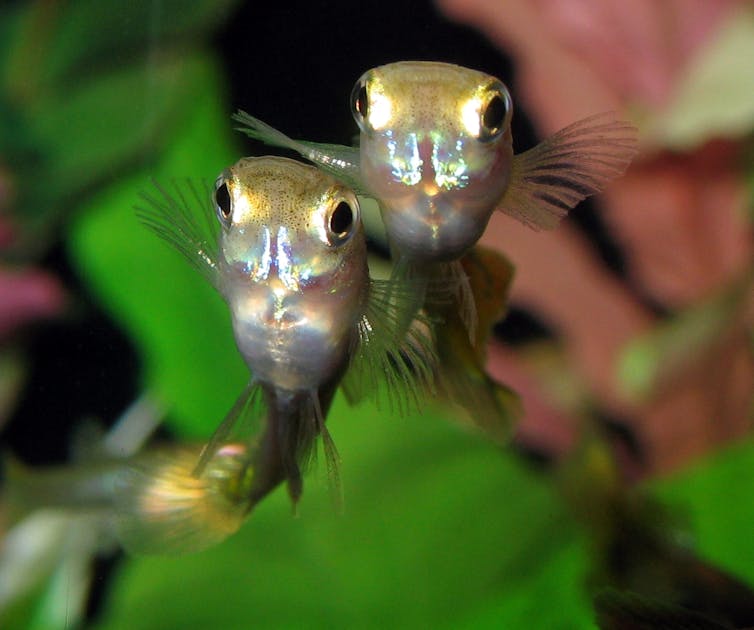
For our recent publication in the Journal of Animal Ecology, we got the opportunity to write a blog about the findings of our results in plain language. Briefly, we studied the effects of Prozac on male guppies and found that low doses of fluoxetine had stronger negative effects on male guppies’ physiology and behaviour than high levels. Fluoxetine also disrupted male pace-of-life syndrome and impacted their potential reproductive success. Read more below:

We’ve also written an article about the drug and our findings in the conversation, read it below:

Fish on Prozac: chemical residues in wastewater mess with bodies, behaviour and sperm

Alice Chaos

Upama Aich, Monash University; Bob Wong, Monash University, and Giovanni Polverino

Antidepressants have helped millions of people worldwide since the 1950s. But have you ever wondered what happens to these drugs once they leave our bodies?

We wanted to study the effects of pharmaceutical pollution on freshwater fish.

Our new research shows even low levels of the antidepressant fluoxetine – sold under the brand name Prozac, among others – will harm male guppies over time. In laboratory experiments, males exposed to fluoxetine at levels they would likely encounter in the wild suffered wide-ranging consequences.

As our reliance on medication grows, so too does the burden we place on natural systems. If we fail to understand the effects of pollution on wildlife, we risk compromising the health of our ecosystems and the services they provide.

Three guppies (side view), top male, bottom females
Male guppies (above) are smaller than females (below) and more sensitive to environmental pollution. Per Harald Olsen, Wikimedia, CC BY

Drugs in our waterways

When we take our medicine, only some is absorbed by our bodies. Most passes through largely unchanged, in urine.

Wastewater treatment plants were not designed to remove these residues. So vast quantities of drugs are released into the environment, along with treated wastewater, worldwide.

This means organisms in waterways downstream from wastewater treatment plants are likely to be bathed in a cocktail of human medicines.

Over time, exposure to these contaminants can potentially disturb animal behaviour, physiology and reproduction. Of particular concern are drugs such as antidepressants, which have been specifically designed to alter brain chemistry in humans.

In recent decades, antidepressants such as Prozac (fluoxetine) have been detected in rivers, lakes and streams across the globe.

Fluoxetine has become one of the most common pharmaceuticals found in our waterways worldwide, including here in Australia.

Fish on chill pills

Despite the obvious differences between humans and fish, we share remarkable similarities.

Pharmaceuticals designed for humans can affect fish and other species because they target receptors we have in common.

Prozac and other brands of fluoxetine increases levels of serotonin in the brain, which increases feelings of wellbeing and happiness. In fish, serotonin is also involved in reproduction, food intake and growth, stress and multiple behaviours.

So it’s not surprising fluoxetine can affect fish. Evidence suggests the effects can be specific to the life stages or even the sex of the fish.

What is surprising is most studies focus on short-term exposure, even though drugs such as fluoxetine can be highly persistent in the environment and affect fish over long periods.

We collected 3,600 wild guppies (Poecilia reticulata) from Alligator Creek in North Queensland. Water samples from the fish collection site showed no contamination with fluoxetine.

A natural waterway surrounded by bushland
The guppy collection site. Jack Manera

Back at the lab, we exposed 15 successive generations of these fish to fluoxetine over five years.

Fish were randomly assigned to one of three levels of exposure, no fluoxetine (control), “low” or “high”. The “low” treatment level represents common surface water concentrations. “High” represents levels typically found in bodies of water heavily dominated by human effluent.

Sex in contaminated water

We found male guppies exposed to low fluoxetine levels were in poor condition, using a measurement similar to body mass index (BMI) in humans. The modified fin male guppies use to inseminate females (gonopodium) was also larger in these males.

Having longer gonopodia helps with mating. So exposure to fluoxetine seemed to trigger a trade-off between physical and reproductive health. When the maintenance of body condition became too costly, the fish put more energy into growing a larger gonopodium.

Low levels of fluoxetine also decreased sperm motility. This means the sperm of exposed males were poor swimmers compared to the sperm of unexposed males.

Female guppies are capable of mating with multiple males. So sperm from different males can compete within the female to fertilise the eggs. Lower sperm motility can therefore reduce the reproductive success of males exposed to fluoxetine.

Strangely, the low-fluoxetine treatment had stronger effects than the high-fluoxetine treatment. But this type of dose-dependent relationship is often found for such drugs and various mechanisms may be at play, such as desensitisation towards higher doses.

Under the influence

Aside from the effects on reproduction, we also studied how fluoxetine exposure affects the activity and hiding behaviour of guppies. Both behaviours are crucial to survival in the wild.

Male guppies exposed to fluoxetine became less capable of adjusting their behaviour in different contexts. They were repeatedly more consistent in their behaviour. In the wild, this can reduce an individual’s ability to respond to environmental changes. For example, consistent behaviour can make a fish an easy target for predators, while unpredictable behaviours can reduce their vulnerability.

Our findings add to a growing body of evidence showing similar behavioural disturbances in exposed wildlife. For example, other studies found antidepressants such as fluoxetine can make fish less active. This could disrupt their ability to compete for food and mates.

Why this matters

Antidepressants can be life-saving for people but pose problems when they find their way into the environment.

Our research has uncovered effects on fish that were largely underappreciated and overlooked, until now. The effects of prolonged exposure to such pollutants demands further investigation.

This will be crucial if we are to develop effective strategies for protecting and managing sensitive aquatic ecosystems, such as better wastewater treatment processes.

Upama Aich, Postdoctoral Research Fellow in the School of Biological Sciences, Monash University; Bob Wong, Professor of Behavioural and Evolutionary Ecology, Monash University, and Giovanni Polverino, Assistant Professor in behavioural ecology

This article is republished from The Conversation under a Creative Commons license. Read the original article.